Choosing a Crib: Space, Materials and Longevity
Notice No. 06
CHILD
2/21/20262 min read

Quick Take
If your priorities are safety, low-tox materials, and restraint, the IKEA SNIGLAR remains one of the most compelling crib options, particularly given its cost. If starting from scratch and seeking a single solution that evolves with the child, a convertible system such as Nestig or Yuzu is worth serious consideration, especially in smaller homes.
A Question of Space and Materials
Cribs are one of the few baby items where compromise feels inappropriate. Safety, materials, and longevity matter, but so does scale. In a condo, the footprint of a crib is not abstract; it shapes how a room functions over time. The decision becomes less about aesthetics and more about how an object lives in space.
Long-Term Use
IKEA SNIGLAR
The SNIGLAR remains a consistently recommended option.
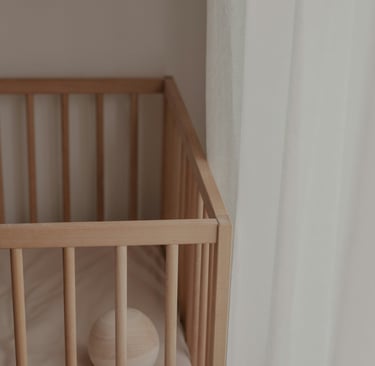
It is solid wood, unfinished, and free of paints, stains, or unnecessary coatings. From a materials standpoint, it is among the cleanest options available, regardless of price. The absence of glues and finishes is not a design statement; it is a functional one.
Its simplicity is its strength. It is sturdy, unassuming, and does exactly what it needs to do. In many ways, it exceeds expectations set by its cost.
The limitation is size. In a condo, the footprint is noticeable, not prohibitive, but something to account for early.
The Bedroom Phase
Babyletto Origami Mini Crib
For the first months, a mini crib such as the Babyletto Origami works well within the constraints of a smaller space.
It is compact, visually quiet, and easy to live with. For a newborn sleeping close by, it offers enough room without overwhelming the bedroom. Around six months, as mobility increases, the limits become clear. At that point, the transition to a full‑size crib feels both natural and necessary.
On Bassinets
Design Dua Bassinet
Finding a genuinely low‑tox, natural bassinet in Canada can be difficult. The Design Dua comes closest to aligning with those priorities.
Initially, it is well made and visually refined. It serves its purpose for the newborn phase. Over time, however, small issues may emerge—movement can introduce noise, and hardware may loosen, reducing long‑term confidence.
It may not be a product one would repurchase, but it can still fill a gap when options are limited, and its use is brief by design.
Convertible Cribs Worth Considering
For families purchasing with longevity in mind, these systems stand out.
Nestig
Thoughtfully designed, with low-tox materials and a clear progression from bassinet to mini crib to full-size crib. The design is restrained, and the availability of low-tox mattress options for smaller configurations is notable.
Yuzu 8-in-1
A more budget-conscious alternative that still prioritizes adaptability. It converts through multiple stages, making it a viable single-solution option from birth onward.
Both represent a higher upfront cost, but one that may replace several separate sleep setups over time.
A Note on Montessori Beds
Some families choose to begin with, or transition early to, a Montessori‑style floor bed. This approach is not covered in depth here, but it remains an option worth noting for those prioritizing long‑term minimalism and autonomy.
Final Take
A low‑tox, solid‑wood crib remains the most reliable foundation, offering better materials and fewer unnecessary finishes. In smaller bedrooms, beginning with a mini crib creates breathing room and keeps the space functional during the newborn phase. Once mobility increases, transitioning to a full‑size crib becomes both practical and necessary. For families with the budget and desire to reduce redundancy, a well‑designed convertible system can replace multiple sleep setups over time. Ultimately, a crib is a functional object that should justify its presence through its materials, its proportions, and its ability to endure.